



How will Lonsdale Energy’s new urban heat recovery centre work?
Lonsdale Energy’s urban heat recovery centre will capture heat from water used for everyday activities like showering, laundry, and washing dishes. That recovered heat will help warm homes and businesses connected to the community energy network.
Where does the heat come from?
Daily activities like showering, washing dishes, and doing laundry send large amounts of warm water down the drain. We capture and recycle that lost heat, turning it into a reliable source of low-carbon energy for buildings throughout the city.
How will this energy centre benefit the community?
Buildings are the second largest source of emissions in the City of North Vancouver, accounting for about 42% of community-wide GHG emissions. Expanding renewable energy is a key part of meeting climate targets. Once operational, this facility will help Lonsdale Energy achieve its goal of supplying 40% of energy from low-carbon sources.
Where will this energy centre be located?
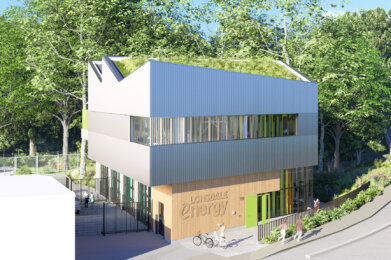
It will be located on City-owned land at 720 W. 2nd Street, near the Fell Street bridge. The site was formerly used to store pipes and construction materials.
How will the surrounding environmment be impacted?
As part of the project, there is over 700m2 of environmental restoration and enhancement both onsite and in the adjacent riparian zone. Restoration work will improve ecosystem functions, such as stabilizing soils to prevent erosion and providing shade to cool both stream and air temperatures. The majority of trees in the area were retained (six were lost), and we will plant 48 new trees. Additionally, the building’s green roof, seeded with wildflowers, will contribute to the city’s pollinator meadows program, enhancing biodiversity and creating valuable habitat for bees, butterflies and hummingbirds.
Is the facility being designed and built with odor-suppression features?
We do not expect that odour will be generated, as the energy centre is a closed system. That said, at the connection point to the wastewater line, we will be including a ventilation system, with odor suppression similar to what’s in typical municipal pump stations. There are several examples of these already in use within the City.
Is there any risk of wastewater spills or leaks? Does the wastewater get removed from existing sewage lines at any point in the process?
A portion of the flow from the existing sewer main is temporarily diverted to the facility, where heat is recovered using a closed-loop heat exchange process. The water then returns to the existing wastewater system. The risk of a spill is very low. The Urban Heat Recovery Centre is designed to safely handle the water and includes multiple safeguards to minimize the risk of leaks or spills. The facility also includes multiple drainage and containment measures that allow any water from a potential spill to be safely directed back to the wastewater system.
Will there be noise from the new energy centre?
The heat pumps and other equipment will produce some operational noise, but the facility has been designed to minimize noise transmission to the surrounding area. The building and equipment will be designed to meet the City of North Vancouver’s applicable noise bylaw requirements.
How does this relate to the North Shore Wastewater Treatment Plant?
These projects are different and led by different organizations. Lonsdale Energy is responsible for the Urban Heat Recovery Centre project, and Metro Vancouver is responsible for the North Shore Wastewater Treatment Plant Program.
How much emissions reduction will it deliver?
The centre is expected to reduce our emissions by about 40% in its first year. That equals roughly 7,600 tonnes of CO₂e each year, or the same as taking 2,700 gas-powered cars off the road.
What is being done to protect the eagle's nest near the project site?
Eagle protection measures are being implemented under the authorization of the B.C. Ministry of Water, Land and Resource Stewardship, in partnership with the Hancock Wildlife Foundation. These measures include temporary nest deterrents, construction and noise buffers, environmental monitoring and protocols to limit disturbance during construction. Eagle-related monitoring and protection measures are being overseen by the appropriate environmental professionals and organizations. For questions about the bald eagles, nest management or wildlife protection measures, please contact the Hancock Wildlife Foundation at office@hancockwildlife.org.
Will the site be open to the public?
The facility will not be publicly accessible, however, parts of the interior will be visible from the street. Signage will be added near the building to help explain how community energy systems work and to highlight Lonsdale Energy's role in supporting the City of North Vancouver's climate goals.
You may contact the onsite construction team, PCL Constructors Westcoast Inc. at 778-389-9248 or grhamilton@pcl.com.